| |
|
|
|
|
| |
 |
|
| |
Securing Asia Pacific’s Energy Future in an Age of Uncertainty: Nuclear, New Technologies & Regional Collaboration |
|
| |
|
|
| |
Opening Keynote Address
Charles Oppenheimer, Founder/CEO, Oppenheimer Energy
Confirmed Speakers
Nobuo Tanaka, Chair, Study Group on Next Generation Nuclear Energy Utilization, Canon Institute of Global Studies (CIGS); Chair, the Steering Committee,
Innovation for Cool Earth Forum (ICEF), Executive Director Emeritus, The International Energy Agency (IEA), CEO, Tanaka Global, Inc.
Francois Morin, Director, China, World Nuclear Association
Karolina Lisslö Gylfe, Secretary General, WePlanet
Dr Whang JooHo, Outside Director of HanmiGlobal, former President and CEO of Korea Hydro and Nuclear Power, former President of Korean Nuclear Society,
former Provost of Kyung Hee University
Gayatri Karnik, Nuclear Industry Analyst, Super Critical Materials; Extended Member – India Sub-Committee on Sustainability, ASME (The American Society of Mechanical
Engineers); Policy Analyst, Anthropocene Institute
Manmohan Parkash, Global Thought Leader and Infrastructure Financing Expert/Former Senior Adviser, Office of the President, Asian Development Bank
Dr. Jeffrey R. Bohn, Director Energy Economics, Anthropocene Institute and Researcher, U.C. Berkeley’s Center for Data Analytics in Risk (CDAR)
Bob S. Effendi, Director, PT XPERT SYNERGY SOLUTION
Steve Reynolds, Technical Programme Manager, Waste and Decommissioning, UKAEA
Pinar Temocin, Political Scientist, Non-Residential Fellow, Elliot School of International Affairs
Dr Carlo A Arcilla, Full Professor of Earth Sciences, University of the Philippines; Immediate Past Director, Philippine Nuclear Research Institute;
Independent Director, PXP Energy, A. Brown Co. Inc and Meralco Power Academy
Keisuke Sadamori, Research Director, Canon Institute for Global Studies
Connie Ye, Senior Consultant, GNE Advisory Pte Ltd
Yongsoo Hwang, Ph D, Distinguished Professor, International Nuclear Nonproliferation and Cooperation Centre, KEPCO International Nuclear Graduate School(KINGS)
Tea Törmänen, Head of Global Development, WePlanet
Axel Canbakan, Global Nuclear Strategy & M&A Advisor, CEO, Damona
Dr Jesús Alejandro Pineda, Data Scientist, Anthropocene Institute
Guido Núñez-Mujica, Director of Data Science/Senior Policy Advisor, Anthropocene Institute
Chi Cheung (CC) Tang, former Managing Director, Hong Kong; Nuclear Investment Company Limited, former Senior Director – Nuclear, CLP Holdings Limited,
Former Independent Non-Executive Director, CGN Power Co. Ltd.
Peter Kurz, Chairman, Alpha Ring Asia |
|
| |
|
|
| |
As geopolitical tensions reshape global energy markets, supply chains remain vulnerable, and energy demand surges—driven in part by rapid digitalisation and the growth of data centres—Asia faces a defining challenge: how to secure reliable, low-carbon, and scalable energy for the future. Nuclear energy development now depends on moving from policy ambition to investable deliverable projects.
Into its 10th year,APNE26 in Macau will bring together government leaders, utilities, technology innovators, financiers, and industrial energy users to explore how nuclear power—alongside emerging technologies—can deliver energy security, resilience, and decarbonisation at scale.
Positioned at the heart of the Greater Bay Area (GBA), APNE26 provides a unique platform to connect China, Northeast Asia, and Asia Pacific, fostering dialogue, investment, and collaboration across borders.
Securing Asia’s Energy Future Starts Here.
As global uncertainty reshapes energy markets, Asia faces a critical challenge:
- Energy Security & Policy – Why nuclear matters now in a more volatile, demand-intensive Asia Pacific
- Finance & Bankability – How projects become investable : risk allocation, government support, long-term offtake and capital structures
- New Nuclear & Fuel-Cycle Innovation – SMRs, advanced reactors, fast reactors, metallic fuel pyroprocessing and future deployment pathways
- Digital Demand & Industrial Capability – AI/data centres, 24/7 clean power, supply chains, localisation, skills and nuclear grade manufacturing
- Regional Deployment & Collaboration – Lessons from mature programmes and emerging markets including China, India, Vietnam, Philippines, Indonesia
|
|
| |
|
|
| |

We are delighted to have Alpha Ring/WI Harper join us as Lunch Sponsor – Alphas Ring is a fusion technology company pursuing compact, modular approaches to clean energy through proton-borron fusion research bringing together expertise in plasma physics, advanced engineering, simulation and diagnostics to explore new pathways toward practical fusion energy.
WI Harper Group is a venture capital firm headquartered in San Francisco, with more than 30 years of experience backing innovative companies and deep connections across Asia. WI Harper focuses on frontier computing and AI, advanced manufacturing, robotics and materials, healthcare and life sciences, and fusion and clean energy. Combining patient capital with hands-on support, the firm helps entrepreneurs translate scientific and technological breakthroughs into scalable businesses, connecting them with strategic partners, customers, manufacturing resources and global markets.
Alpha-E
Fusion is moving from the lab to the market. Your students shouldn’t be learning it from slides.
Plasma and fusion science underpin strategic industries such as advanced manufacturing, materials science, and a fusion energy sector heading for commercialization, yet most universities and workforce programs can’t put real instrumentation into students’ hands. Alpha-E changes that. By shrinking instruments that once demanded a dedicated facility into systems that fit on a benchtop, this family of devices brings working plasma and fusion science into the classroom and research lab:
- Alpha-E Plasma: a compact ECR plasma system for teaching
- Alpha-E Prime: a particle accelerator built for teaching
- Alpha-E Pro: a research-grade accelerator for low-flux applications
Alpha-E is a breakthrough in how plasma and fusion are taught. Students control the reactions directly and analyze the resulting data to build their science intuition. Every system includes curriculum, installation, and ongoing support, so programs can start teaching with the devices quickly and easily.
Meet us at APNE26 to see how it works or see the Alpha-E family at alpha-e.ai |
|
| |
|
|
| |
Conference Programme
Day 1, Thursday, 5th November 2026
|
| 8:00 |
Registration & Morning Coffee |
| |
Policy Deployment, Investment & Energy Security |
| 9:00 |
Chairman’s Opening Address
Karolina Lisslö Gylfe, Secretary General, WePlanet, Sweden |
| 9:10 |
Opening Keynote
The Nuclear Developer Model for Finance and Project Execution
- Cooperation, capital and the developer model from North America to Asia
Charles Oppenheimer, Founder/CEO, Oppenheimer Energy |
| 9:40 |
Powering the AI Era : Bridging the Energy Gap in Asia Pacific and Beyond
- Global Energy Demand – How AI and data center expansion are reshaping electricity demand, particularly in Asia Pacific
- Energy and Funding Challenges – Infrastructure bottlenecks, power shortages and investment constraints
- Advanced Energy Solutions – The role of fusion and other emerging technologies in addressing long-term energy needs
- Alpha Ring’s Global Perspective – Its fusion technology development, international research collaborations and relevance to Asia Pacific
- Regional Opportunities – Investment, innovation and cross-border collaboration to advance the region’s energy future
Peter Kurz, Chairman, Alpha Ring Asia |
| 10:10 |
Executive Panel Session
The New Nuclear Supply Chain: From Reactor Vendor to Multi-Country Delivery Consortium
As nuclear ambitions accelerate across Asia-Pacific, the traditional model of a reactor vendor delivering a largely self-contained project is evolving. Future programmes will increasingly depend on international consortia bringing together reactor technology, engineering, construction, manufacturing, fuel, financing and local industrial capability. The session will explore what this new delivery ecosystem could look like — and how Asia-Pacific countries can build resilient, bankable and scalable nuclear programmes.
The US-Japan- Korea trilateral SMR collaboration as a compelling real-world example and the question of how the next generation of nuclear projects will be delivered across Asia Pacific.
Moderator:
Karolina Lisslö Gylfe, Secretary General, WePlanet
Panelists:
Charles Oppenheimer, Founder/CEO, Oppenheimer Energy
Dr Whang JooHo, Outside Director of HanmiGlobal, former President and CEO of Korea Hydro and Nuclear Power, former President of Korean Nuclear Society, former Provost of Kyung Hee University
Yongsoo Hwang, Ph D, Distinguished Professor, International NuclearNonproliferation and Cooperation Centre, KEPCO International Nuclear Graduate School (KINGS)
Chi Cheung (CC) Tang, former Managing Director, Hong Kong Nuclear Investment Company Limited, former Senior Director – Nuclear, CLP Holdings Limited, Former Independent Non-Executive Director, CGN Power Co. Ltd.
Peter Kurz, Chairman, Alpha Ring Asia |
| 10:50 |
Networking Moring Coffee |
| 11:20 |
Nuclear Energy Lowers Emissions, Stabilises Prices and Supports Renewables: The Case of (and for) Diablo Canyon
The case of the Diablo Canyon Nuclear Power plant is used as a clear example of the benefits of nuclear energy as a moderating influence on energy prices and emissions. We will show several lines of evidence, such as hourly electricity generation, hourly prices and their volatility, electricity imports from coal and other high emission sources, import-export balance, how NPP shutdowns impact prices and imports, and prices during periods when nuclear energy outgenerates natural gas and imports. These all provide more than enough technical arguments in favor of keeping Diablo Canyon functioning for the foreseeable future, if California wishes to reduce emissions and keep electricity prices under control. Finally we will comment briefly on how lacking political leadership has failed repeteadly to make the public case for the benefits of nuclear energy to Californians.
Dr Jesús Alejandro Pineda, Data Scientist, Anthropocene Institute
Guido Núñez-Mujica, Director of Data Science/Senior Policy Advisor, Anthropocene Institute |
| 12:00 |
 |
| 1:30 |
The Great Indian Nuclear Growth Story : Challenges and Opportunities
- Policy and regulatory evolution
- Government support and private-sector participation
- Nuclear liability and investment conditions
- Growth opportunities and remaining barriers
Gayatri Karnik, Nuclear Industry Analyst, Super Critical Materials; Extended Member – India Sub-Committee on Sustainability, ASME (The American Society of Mechanical Engineers); Policy Analyst, Anthropocene Institute |
| 2:00 |
Securing Asia Pacific’s Energy Future: Nuclear Pathways for Energy Security, Economic Growth and Net Zero
- The changing energy landscape in Asia Pacific: geopolitics, energy security, rising electricity demand and decarbonisation.
- Comparative assessment of nuclear strategies across Asia Pacific, including China/Hong Kong/Macau, India, Japan, Korea, Singapore, Malaysia, Indonesia, the Philippines and Vietnam.
- India as a case study: policy reforms, indigenous capability, financing, private sector participation and future growth.
- Lessons from mature and emerging nuclear programmes across the region.
- Opportunities for regional collaboration in financing, technology, fuel security, supply chains, workforce development and regulatory harmonisation.
- Strategic priorities for building a resilient, secure and low-carbon energy future for Asia Pacific.
Manmohan Parkash, Global Thought Leader and Infrastructure Financing Expert/Former Senior Adviser, Office of the President, Asian Development Bank |
| 2:30 |
Financing for Advanced Nuclear Reactors
Exploring financing pathways to deploy advanced nuclear reactors at scale, from early technology development to commercial fleet deployment
Axel Canbakan, Global Nuclear Strategy & M&A Advisor, CEO, Damona |
| 3:00 |
Networking Afternoon Tea |
| 3:30 |
Fireside Chat
From Policy Ambition to Bankable Nuclear Projects - Financing, Risk and Delivery in Asia Pacific
A senior level conversation on the final gap between political intent and commercial reality.
Asia-Pacific’s nuclear ambitions will only translate into projects if governments, utilities, technology providers and investors can establish credible financing and risk-sharing structures. This senior-level closing conversation will explore what it will take to move nuclear projects from political commitment and early planning to investment, construction and delivery.
- What makes a nuclear project genuinely bankable?
- What investors require before committing long-term capital
- Government support, sovereign guarantees and policy certainty
- Allocating risk among governments, utilities, developers, investors and insurers
- Financing models including RAB, CfD, PPPs and export-credit support
- The role of development banks and strategic investors
- Financing SMRs, advanced reactors and first-of-a-kind technologies
- Long-term offtake agreements with data centres and industrial energy users
- Lessons from India and other emerging nuclear markets
- Turning regional collaboration into investable, deliverable projects
Dr. Jeffrey R. Bohn, Director Energy Economics, Anthropocene Institute and Researcher, U.C. Berkeley’s Center for Data Analytics in Risk (CDAR)
Francois Morin, Director, China, World Nuclear Association
Manmohan Parkash, Global Thought Leader and Infrastructure Financing Expert/Former Senior Adviser, Office of the President, Asian Development Bank
Gayatri Karnik, Nuclear Industry Analyst, Super Critical Materials; Extended Member – India Sub-Committee on Sustainability, ASME (The American Society of Mechanical Engineers); Policy Analyst, Anthropocene Institute |
| 5:00 |
Chairman’s Closing Comments and Close of Day 1 |
5:30 -
7:00 |
Networking Evening Drinks |
|
|
| |
|
|
| |
Day 2, Friday, 6th November 2026
|
| |
Advanced Technology, Digital Demand, Fuel Cycle, Supply Chains & Delivery |
| 8:30 |
Registration & Morning Coffee |
| 9:00 |
Chairman’s Morning Address
Tea Törmänen, WePlanet |
| 9:10 |
Morning Keynote
Winning the Public: Why Nuclear’s Future Depends on Narrative, Not Just Reactors
Nuclear is now a societal and political question, not just a technical one. Public trust, perception, and misinformation are decisive factors. Why current communication strategies are failing to match the moment. The role of civil society and new coalitions in shifting public acceptance. Moving from defensive messaging to a compelling, future-oriented narrative. What it will take to secure a lasting social licence for nuclear at scale.
Karolina Lisslö Gylfe, Secretary General, WePlanet |
| 9:40 |
Nuclear Economics Across Markets: Why Costs Differ and What can Improve
- Global nuclear energy economics project
- Data vary widely across countries
- Overnight construction costs
- Financing costs
- Operating costs
- Construction duration
- USA’s outlier status
- Nuclear energy economics are improving (in most countries)
Dr. Jeffrey R. Bohn, Director Energy Economics, Anthropocene Institute and Researcher, U.C. Berkeley’s Center for Data Analytics in Risk (CDAR) |
| 10:10 |
Flagship Panel:
Closing the Nuclear Fuel Cycle: IFR-Type Fast Reactors, Metallic Fuel & Pyroprocessing for Asia’s Energy Future
As Asia accelerates its nuclear energy ambitions, attention is increasingly turning to advanced reactor systems that can improve fuel utilisation, reduce long-lived waste, and strengthen energy security. IFR-type technologies — combining fast reactors, metallic fuel and pyroprocessing within a closed fuel cycle — offer a potential pathway to extract more energy from nuclear fuel while reducing dependence on fresh uranium supply and long-term waste storage.
A focussed discussion on closed-cycle fast-reactor systems and their implications for resource efficiency, waste, safeguards and long term energy security.
- Fast reactor and metallic-fuel fundamentals
- Pyroprocessing and integrated fuel recycling
- Lessons from programmes globally
- China’s development pathway - An overview of China’s fast reactor and closed fuel cycle ambitions, including how IFR-type technology could support national energy security and nuclear innovation goals.
- Commercialisation challenges - Technical, regulatory, economic and safeguards issues that must be addressed before IFR-type systems can be widely deployed.
- Non-proliferation and safeguards - Managing the sensitive policy questions around pyroprocessing, fuel recycling and advanced nuclear materials.
- Potential role in Asia Pacific’s future energy system
Moderator:
Nobuo Tanaka, Chair, Study Group on Next Generation Nuclear Energy Utilization, Canon Institute of Global Studies (CIGS); Chair, the Steering Committee, Innovation for Cool Earth Forum (ICEF), Executive Director Emeritus, The International Energy Agency (IEA), CEO, Tanaka Global, Inc.
Panelists:
Keisuke Sadamori, Research Director, Canon Institute for Global Studies
Dr. Whang JooHo, Outside Director of HanmiGIobaI, former President and CEO of Korea Hydro and Nuclear Power, former President of Korean Nuclear Society,
former Provost of Kyung Hee University |
| 11:00 |
Networking Moring Coffee |
| 11:30 |
Building legal and regulatory frameworks to support the utilisation of nuclear energy in the Asia Pacific?
Connie Ye, Senior Consultant, GNE Advisory Pte Ltd |
| 12:00 |
The Role of Nuclear Technologies in Japan’s 2050 Carbon Neutrality Agenda: Stakeholder Perspectives, Legitimacy, and Energy Transition Governance
- Nuclear legitimation and stakeholder engagement.
- Japan's roadmap to 2050 carbon neutrality – how nuclear energy is being positioned alongside renewable energy to deliver a secure, reliable, and low-carbon energy system.
- Restarting and replacing nuclear capacity – policy reforms, next-generation reactors, and stakeholder strategies supporting Japan's nuclear renaissance.
- Driving innovation through advanced nuclear technologies – SMRs, advanced reactors, shaping the future energy mix.
- Balancing energy security, economic competitiveness, and decarbonization – lessons from Japan's integrated approach to energy planning in an uncertain geopolitical environment.
Pinar Temocin, Political Scientist, Non-Residential Fellow, Elliot School of International Affairs |
| 12:30 |
Networking Lunch |
| 1:30 |
Chairman’s Afternoon Address
Jun Kojima, Advisor, Anthropocene Institute; Director, Ant Capital Partners (Japanese Private Equity |
| |
Emerging Nuclear Markets Spotlight – From Ambition to National Deployment |
| 1:40 |
How Chinese Nuclear Model can Apply to Global South Countries
- Chinese programme started decades ago with technology transfer, no industry and no money
- Low cost of capital : the key to profitability and the building of an industry. True in China; true elsewhere?
- Do SMR projects actually modify the path to success?
- The dual aspect heat versus electrictity, the Chinese case versus other countries. District and Industrial heating, who is concerned?
Francois Morin, Director, China, World Nuclear Association |
| 2:10 |
Indonesia: Ready for 7GW nuclear by 2040
- Regulations umbrella
- Latest Update
- When and what capacity (large scale vs SMR)
- Potential Site : 28 location and others
- Who has engaged Indonesia
- What's next? if you're a) advanced nuclear developer b) large scale reactor vendor c) nuclear investor d) nuclear consultants
Bob S. Effendi, Director, PT XPERT SYNERGY SOLUTION |
| 2:40 |
Nuclear Developments in the Philippines
- New nuclear law and independent regulatory
- Urgent need for nuclear baseload
- Potential private nuclear companies
- Potential sites for nuclear
- Small nuclear modular research in the Philippines
- Non nuclear power research applications (Nutec plastics)
Dr. Carlo A Arcilla, Full Professor of Earth Sciences, University of the Philippines
Immediate Past Director, Philippine Nuclear Research Institute
Independent Director, PXP Energy, A. Brown Co. Inc and Meralco Power Academy |
| 3:10 |
Networking Afternoon Tea |
| 3:40 |
Advanced Technology Case Study
Ensuring Fusion Energy's Regenerative Economy - UKAEA's development of detritiation technologies to ensure a recycling path for fusion fuel
- UKAEA's fusion energy research
- The Joint European Torus and fusion experience gained
- Fusion waste types generated at UKAEA and current disposability
- UKAEA's developed detritiation technologies
- Current research underway on fusion waste
Steve Reynolds, Technical Programme Manager, Waste and Decommissioning, UKAEA |
| 4:10 |
Closing Executive Roundtable
The Asia Pacific Nuclear Roadmap: Collaboration, Confidence & Delivery
A high-level closing discussion bringing together the key themes of APNE26: energy security, technology innovation, investment, supply chains, public confidence and regional collaboration.
- What Asia Pacific needs to accelerate nuclear deployment
- How governments, industry and investors can work together
- The role of regional collaboration in building confidence
- Moving from ambition to implementation
- Priority actions for the next 5–10 years
- Building public trust and a stronger nuclear narrative
Moderator:
Stephen Reynolds, Technical Programme Manager, Waste and Decommissioning, UKAEA
Panelists:
Yongsoo Hwang, Ph D, Distinguished Professor, International Nuclear Non-proliferation and Cooperation Centre, KEPCO International Nuclear Graduate School (KINGS)
Dr Carlo A Arcilla, Full Professor of Earth Sciences, University of the Philippines
Immediate Past Director, Philippine Nuclear Research Institute
Independent Director, PXP Energy, A. Brown Co. Inc and Meralco Power Academy
Bob S. Effendi, Director, PT XPERT SYNERGY SOLUTION
Connie Ye, Senior Consultant, GNE Advisory Pte Ltd |
| 5:45 |
Chairman’s Closing Remarks and Key Takeaways |
|
|
| |
|
|
| |
Opening Keynote Address:
 |
Charles Oppenheimer
Founder/CEO, Oppenheimer Energy
Charles Oppenheimer is an investor and entrepreneur based in Silicon Valley.
As a founder of The Oppenheimer Project and member of 8090 Industustries, he is advocating and investing in the expansion of nuclear energy as a pathway to a more energy-abundant and peaceful world. |
|
|
| |
|
|
| |
Panel of Industry Specialists:
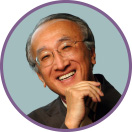 |
Nobuo Tanaka
Chair, Study Group on Next Generation Nuclear Energy Utilization, Canon Institute of Global Studies (CIGS);
Chair, the Steering Committee, Innovation for Cool Earth Forum (ICEF), Executive Director Emeritus,
The International Energy Agency (IEA), CEO, Tanaka Global, Inc.
Nobuo Tanaka is Chairman of the Steering Committee of the Innovation for Cool Earth Forum (ICEF), which was established by former Prime Minister Shinzo Abe in 2014. He was Chairman and President of the Sasakawa Peace Foundation from 2015 to 2020. As Executive Director of the International Energy Agency (IEA) from 2007 to 2011, he initiated a collective release of oil stocks in June 2011 and played a crucial and personal role in strengthening ties with major non-member energy players, including China and India.
He began his career in 1973 at the Ministry of Economy, Trade and Industry (METI), where he served in several high-ranking positions, including Director-General of the Multilateral Trade System Department. He was deeply engaged in bilateral trade issues with the United States while serving as Minister for Industry, Trade and Energy at the Embassy of Japan in Washington, DC. He also served twice as Director for Science, Technology and Industry (DSTI) at the Paris-based Organisation for Economic Co-operation and Development (OECD).
As CEO of Tanaka Global Inc., he advises several Japanese and international companies. He graduated from the University of Tokyo and holds an MBA from Case Western Reserve University. He is currently a Distinguished Fellow at the Center on Global Energy Policy, Columbia University, and at the Institute of Energy Economics, Japan (IEEJ). He also chairs the Study Group on Next Generation Nuclear Energy Utilization at the Canon Institute for Global Studies (CIGS).
|
 |
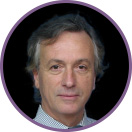 |
Francois Morin
Director, China, World Nuclear Association
François Morin is senior engineer, graduate of the Ecole Centrale de Paris (ECP) and worked several years as process engineer in Framatome (now AREVA), in charge of accident evaluation and post-Chernobyl studies. In the 90’s he worked within French Atomic Energy Commission and managed technology transfers into China in the field of Nuclear Medicine.
He then has been working in various fields and countries, Eastern Europe, Asia, Africa, focused on big projects structuring & financing involving international cooperation. He is currently living in China. He is Director Asia at the World Nuclear Association. |
|
 |
Karolina Lisslö Gylfe
Secretary General, WePlanet, Sweden
Karolina Lisslö Gylfe, is Secretary General at WePlanet activewith, champions science-based solutions to global environmental challenges across 18 countries.
Her work bridges the gap between scientific evidence and public understanding, particularly in climate action. As a biologist and ecologist, she brings scientific rigor to environmental advocacy while ensuring solutions are equitable and accessible. Working at the intersection of science, policy, and social impact, she advances evidence-based solutions that serve both people and planet. |
|
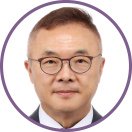 |
Dr Whang JooHo
Outside Director of HanmiGIobaI, former President and CEO of Korea Hydro and Nuclear Power,
former President of Korean Nuclear Society, former Provost of Kyung Hee University
Dr. Jooho Whang is an Outside Director of HanmiGlobal, the largest PM/CM company in Korea. He completed, last year, his term as President and CEO of Korea Hydro & Nuclear Power Co., Ltd. (KHNP), the largest power generation company in Korea, which operates 26 nuclear power units as well as numerous hydro and pumped-storage plants, producing approximately 180 TWh of electricity annually.
During his tenure, KHNP achieved the highest ranking in Korea’s public-enterprise performance evaluation for three consecutive years. He successfully completed two large-scale APR-1400 nuclear power units and initiated construction of two additional units. He secured the export of two large units to Czech Republic. He also advanced small modular reactor (SMR) development, establishing cooperative frameworks with domestic and international developers and local governments for future SMR deployment.
Prior to his appointment as CEO, Dr. Whang served as a professor of nuclear engineering for 30 years, during which he chaired both the Korean Energy Engineering Society and the Korean Nuclear Society. As President of the Korea Institute of Energy Research (KIER), he promoted research on renewable-energy technologies, carbon capture, and ammonia utilization, and developed a carbon-neutral regional-energy model. This model later provided the conceptual foundation for KHNP’s SMR Smart Net Zero City (SSNC) initiative — an urban-development concept integrating SMRs with renewable energy and hydrogen production — which was prominently presented at COP28.
Dr. Whang earned his B.S. in Nuclear Engineering from Seoul National University and his Ph.D. in Nuclear Engineering from the Georgia Institute of Technology in the United States. |
|
 |
Gayatri Karnik
Nuclear Industry Analyst, Super Critical Materials;
Extended Member – India Sub-Committee on Sustainability, ASME (The American Society of Mechanical Engineers);
Policy Analyst, Anthropocene Institute
Gayatri Karnik is a Policy Analyst at the Anthropocene Institute, based in India, where she focuses on new nuclear development, nuclear finance, and the broader nuclear value chain. Her work sits at the intersection of energy policy, commercial strategy, and international law. She is an extended member of the American Society of Mechanical Engineers’ (ASME) India Subcommittee on Sustainability and the Taskforce Lead for the OECD Nuclear Energy Agency’s High-Level Group on Improving Gender Balance. She is the Vice-President of Women in Nuclear Global Young Generation. Gayatri is an IAEA Marie Skłodowska-Curie Fellow holding a Master of Laws and a Master’s in International Relations from the London School of Economics and Political Science.
|
|
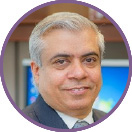 |
Manmohan Parkash
Global Thought Leader and Infrastructure Financing Expert/Former Senior Adviser, Office of the President,
Asian Development Bank
Mr. Parkash is a global thought leader in infrastructure finance with over 40 years of experience across Asia Pacific. He played a pioneering role in the development of high-speed rail in China, mobilising over $25 billion in financing from multiple sources. Over his career at the Asian Development Bank and the Government of India, he has helped shape major infrastructure programs and contributed to the delivery of over 10,000 km of rail projects. His expertise spans blended finance, complex project structuring, and large-scale infrastructure delivery, and he is widely recognised for building high-impact partnerships across governments, multilaterals, and the private sector. |
|
 |
Dr. Jeffrey R. Bohn
Director Energy Economics, Anthropocene Institute and Researcher, U.C. Berkeley’s Center for Data Analytics in Risk (CDAR)
Dr. Bohn is the Director Energy Economics at the Anthropocene Institute. He focuses on data engineering, machine intelligence, climate resilience, and risk modeling for enterprise deployment at financial services and energy companies. He is a board member and researcher at the Consortium for Data Analytics in Risk (CDAR) at U.C. Berkeley. In the past, he was a member of Reprisk’s Advisory Board in Zürich. Most recently, he was the Chief Research & Innovation Officer at the Swiss Re Institute, which he established several years ago in Zürich. In the past, he served as Chief Science Officer at State Street Global Exchange in San Francisco. Before moving back to California, he established the Portfolio Analytics and Valuation Department within State Street Global Markets Japan in Tokyo. Dr. Bohn often conducts seminars on topics ranging from risk & portfolio management to machine learning. He has published widely in the area of risk modeling. He co-authored with Roger Stein Active Credit Portfolio Management in Practice(Wiley, 2009). His recent research focuses on energy transition (with a focus on nuclear), socially responsible machine intelligence, causal inference to improve machine-learning interpretability, quantum computing, and machine-intelligence-enabled tools to assess company & urban resilience. |
|
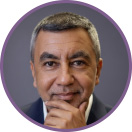 |
Bob S. Effendi
Director, PT XPERT SYNERGY SOLUTION
Bob S. Effendi is an Indonesian energy executive, strategic advisor, and technology consultant with more than 30 years of experience spanning oil and gas, mining, nuclear and clean energy, defense technology, cybersecurity, public policy, and government relations. He is the Founder and Director of PT Xpert Synergy Solution, established in 2024 to provide strategic advisory, project development, and stakeholder engagement across these sectors.
As the former Chief Operating Officer of ThorCon Power Indonesia, Bob spent nearly a decade advancing Indonesia’s nuclear-energy program. He played an important role in reopening the country’s nuclear pathway after nuclear power was designated a “last resort” under the 2014 National Energy Policy. His work involved engagement with senior government officials, regulators, utilities, research institutions, and international nuclear organizations. He continues to support the realization of Indonesia’s first nuclear power plant, including engagement with Danantara and other key national stakeholders.
Bob is also Program Director of the Repower Indonesia Initiative, promoting the conversion of existing coal-power infrastructure to clean energy, particularly through coal-to-nuclear repowering. He has helped develop collaboration among Indonesian institutions and international partners to evaluate how existing power-plant sites, transmission infrastructure, and skilled workforces can be reused to accelerate Indonesia’s energy transition. He also serves as a nuclear advisor to PLN Batam.
In defense, Bob advised a nuclear-propulsion feasibility study project led by the Indonesian Ministry of Defense’s research and development organization from 2018 to 2021. Since 2025, he has advised Komodo Armament Indonesia on regional expansion and collaboration with ASEAN countries seeking to strengthen their domestic weapons and ammunition industries.
In cybersecurity, Bob is the official Indonesian representative of the Independent Information Security Rating Institute and CyberRank.ai. His work focuses on national cyber-risk assessment, personal-data protection compliance, digital resilience, and cybersecurity governance for government institutions, state-owned enterprises, financial institutions, and other strategic organizations.
Bob is a co-founder of the Indonesia Nuclear Professional Association (APRONUKI), the Indonesia New Energy–Nuclear Society (MEBNI), and the Sundalandia Discovery Society. He is also a member of KADIN’s Renewable Energy Task Force and His international engagement extends across Southeast Asia, China, South Korea, Japan, Australia, India, and other key markets, including interactions with organizations such as the IAEA, KAERI, and the Australian Nuclear Association.He earned his degree in Computer Engineering from the University of Bridgeport, Connecticut, in 1988. Combining technical understanding with extensive experience in policy, stakeholder relations, negotiation, and cross-border collaboration, Bob is committed to advancing Indonesia’s energy security, technological sovereignty, digital resilience, and defense-industrial capabilities. |
|
 |
Steve Reynolds
Technical Programme Manager, Waste and Decommissioning, UKAEA
Steve Reynolds started working on fusion materials and waste in 2009 at UKAEA and has continued to work in varying related roles for the subsequent 17 years. Having lead teams managing the waste/materials tracking systems, tritium analysis labs and radioactive waste consignments for fusion waste generated from the Joint European Torus, the largest deuterium-tritium fusion machine in the world, he is now currently the Technical Programme Manager for Waste and Decommissioning in the Tritium Fuel Cycle division responsible for their extensive research programme ensuring fusion is a sustainable and regenerative energy solution. |
|
 |
Pinar Temocin
Political Scientist, Non-Residential Fellow, Elliot School of International Affairs
I am a political scientist specializing in energy governance, sustainability transitions, and public policy, with a regional focus on Japan and the Asia-Pacific. My research examines how emerging low-carbon technologies, particularly nuclear power, are shaped by political institutions, stakeholder dynamics, and processes of legitimacy. Prior to this, I was actively involved in international research collaborations, including work on civic participation in solid waste management in Kerala (TAOYAKA Program, Onsite Team Project), coal phase-out governance (COALSTAKE, Political Economy of Coal Policy, Swiss Network for International Studies), and the co-creation of green transitions (GoGreen Project, Roskilde University). Drawing on perspectives from political sociology, environmental governance, and science and technology studies, my work aims to contribute both to academic debates and to policy-relevant discussions on sustainable energy futures.
I currently serve as a Non-Residential Fellow at the Elliott School of International Affairs and previously held the position of Project Assistant Professor under the Hitachi-UTokyo Lab. at the Institute for Future Initiatives, University of Tokyo, where I worked on the governance of low-carbon technologies. My work combines qualitative and mixed methods and has been published in journals such as Energy Research & Social Science, Climatic Change, and One Earth. |
|
 |
Dr. Carlo A Arcilla
Full Professor of Earth Sciences, University of the Philippines;
Immediate Past Director, Philippine Nuclear Research Institute;
Independent Director, PXP Energy, A. Brown Co. Inc and Meralco Power Academy
Dr. Carlo A. Arcilla is a distinguished geologist and leader with a doctorate in Geotechnical Engineering and Geosciences from the University of Illinois at Chicago. He previously served as the director of both the Philippine Nuclear Research Institute (PNRI) and the National Institute of Geological Sciences (NIGS), where he led groundbreaking projects in nuclear medicine, mining, and environmental applications. Currently, Dr. Arcilla is back at NIGS, where he imparts his expertise to students in the field of Geology.
Dr. Arcilla has been a key figure in national disaster mitigation programs like Project NOAH and the development of innovative solutions, such as the first garbage-fueled electric power plant. He also led significant DOST-funded projects like PROMT and REVIVE PH, focusing on sustainable technologies for mine tailings management and mining site rehabilitation.
Recognized among the top 100 scientists in Asia, Dr. Arcilla’s influence is reflected in the success of his students, many of whom have graduated from prestigious universities and ventured into industries like drilling, gemstones, and chemical analyses. Additionally, he has been a strong advocate for the peaceful use of atomic energy in the Philippines, playing a crucial role in the passage of the PhilATOM Law and its Implementing Rules and Regulations. |
|
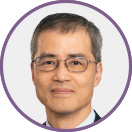 |
Keisuke Sadamori
Research Director, Canon Institute for Global Studies
Keisuke Sadamori has been the Research Director of Canon Instutute for Global Studies (CIGS) since July 2026. He is in charge of energy related affairs in the Institute.
Prior to joining the CIGS, Mr. Sadamori served as the Director of Energy Markets and Security at the International Energy Agency from September 2012 to June 2026. He handled 3 coordinated emergency oil stock releases including the most recent 400 mb release in response to the Strait of Hormuz closure by the US-Iran War.
Before the IEA, he held many senior positions in the Government of Japan including executive assistant to the Prime Minister at the time of the Great East Japan Earthquake and the Fukushima Nuclear Power Plant accident in 2011.
Mr. Sadamori received an LLB from the University of Tokyo in 1983 and a Master in Public Affairs from the Woodrow Wilson School of Public and International Affairs, Princeton University in 1990. |
|
 |
Connie Ye
Senior Consultant, GNE Advisory Pte Ltd
Connie specialises in the development of global energy and critical infrastructure projects. She is based in Singapore, with an interest in civil nuclear project development throughout Asia. She advises sponsors, owners and operators on the structuring, procurement, offtake and implementation aspects of large-scale nuclear new-build projects, including EPC, fuel supply and O&M contracts in Asia and the Middle East. Connie also has experience advising governments on the development of nuclear legal and regulatory frameworks for nuclear newcomer countries.
Connie is a member of the International Nuclear Law Association fusion working group. |
|
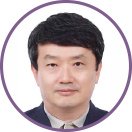 |
Yongsoo Hwang
Ph D, Distinguished Professor, International Nuclear Nonproliferation and Cooperation Centre,
KEPCO International Nuclear Graduate School (KINGS)
Professor Yongsoo HWANG has served as a Distinguished Professor at KINGS giving lectures over Nuclear Fuel Cycle and Non-Proliferation issues. Before joining KINGS as a professor, he served as a President of KINAC, Korea Institute of Nuclear Nonproliferation and Control and a Senior Vice President of KAERI, Korea Atomic Energy Research Institute. He also worked as a Member of the Committe for Korea Nuclear Safety and Security Council between 2014 and 2016. He currently leads the research on these fields as well as the global nuclear export and associated cooperation. He has worked extensively the studied the nuclear fuel cycles and spent nuclear fuel management in association with LWR’s and SMR’s since the middle of 1980’s. He also served as a member and a project manager for the South Korean effort on Public and Stakeholder Engagement for nuclear issues. He served as a member of IAEA special group, “Multi-lateral Nuclear Agreement” on the 1st Iranian Nuclear Impasses between 2024 and 2005. Between 2006 and 2010, he has worked with Sandia National Laboratories and US NNSA, National Nuclear Security Administration over the issues of Nuclear Non-proliferation and Cooperation in East Asia. He also worked on the 123 agreement negotiation between the ROK and the United. He is currently working for the World Bank to assess the feasibility of life time extension of nuclear power stations in the global world. Also, he is writing a book over the Global Nuclear Supply Chain for the CEIP, Carnegie Endowment for International Peace. He served as a visiting scholar at CSIS in DC between 2010 and 2012. He received his BS from Seoul National University and MS/Ph D from UC Berkeley for Nuclear Engineering. |
|
 |
Tea Törmänen
Head of Global Development, WePlanet
Ms. Törmänen is a biologist working as a Head of Global Development at WePlanet, a global movement advocating for human development, science, and technology as drivers of sustainability. She has been with WePlanet since day one, leading the Finnish chapter for four years before expanding her work internationally and being part of establishing the global umbrella organization for the movement. As a proud nuclear advocate for over 20 years, she challenges the notion that environmentalists can’t support nuclear energy. She has been a panelist at COP28 in Dubai and other high-level international events, emphasizing nuclear’s role in climate resilience, clean energy access, and food security. She's also been featured in several documentary films across the globe. Currently, she is deepening her expertise through a Climate Expert Degree programme at the University of Helsinki, studying climate law, policy, and science. |
|
 |
Axel Canbakan
Global Nuclear Strategy & M&A Advisor, CEO, Damona
Axel Canbakan is Managing Partner at Damona, a strategy consultancy dedicated to the nuclear industry. He leads a firm combining deep nuclear expertise with commercial and financial insight to support technology developers, utilities, industrial players and investors. Damona’s work spans growth strategy, due diligence, industrialisation and capital project development, helping clients turn complex nuclear opportunities into viable businesses and projects.
|
|
 |
Jesús Alejandro Pineda
Data Scientist, Anthropocene Institute
Jesús Alejandro Pineda is a physicist, science communicator and data scientist. He holds a Masters and a Doctorate in Physics from Universidad Simón Bolívar in Caracas, Venezuela. He has been an Assistant Professor at Universidad Simón Bolívar where he researched Quantum Groups and Conformal Field Theory and is currently a Data Scientist at the Anthropocene Institute, where he conducts research on the way nuclear energy can reduce emissions, bring down energy prices and their variability and how nuclear energy can have financial upsides through carbon credits and by allowing avenues for economic development. |
|
 |
Guido Núñez-Mujica
Director of Data Science/Senior Policy Advisor, Anthropocene Institute
Guido Núñez-Mujica is a data scientist, computational biologist, and science communicator. Currently, Guido is the Head of Data Science at the Anthropocene Institute and runs his own consulting firm, Greensight Consulting. Prior to working in climate change, Guido was a data scientist in the tech industry, and in 2008 he co-founded Lava-Amp, a biotechnology start-up that aimed to build a portable, low-cost, handheld PCR device, and apply data science to medical diagnostics and epidemiology. His work has been featured in multiple publications, including Nature, Wired, IO9, BoingBoing, BioTechniques, and La Stampa. He is also the subject of a chapter in the book Biopunk: DIY Scientists Hack the Software of Life by Marcus Wohlsen. Currently, Guido is producing a documentary called Silenced Crops on the topic of the destruction of Venezuelan biotechnology by activists. Guido’s latest activism project involves light projections promoting the use of nuclear power to fight climate change. Guido was one of the activists who successfully fought to preserve Diablo Canyon, the last nuclear plant in California. Guido holds a degree in computational and physical sciences, and a Bachelor’s degree in biology from the Universidad de Los Andes in Venezuela. |
|
 |
Jun Kojima
Advisor, Anthropocene Institute; Director, Ant Capital Partners (Japanese Private Equity)
Jun Kojima is a Tokyo-based investment professional, venture capitalist and ecosystem builder with more than 20 years of experience spanning venture capital, private equity, asset management, structured finance, and international business development across the Asia-Pacific region and beyond. He currently serves as an Advisor to the Anthropocene Institute and is a founding member of the Venture Capital at Ant Capital Partners, one of Japan's leading private equity firms. In this role, he is responsible for fund strategy, deal sourcing, investment execution, and portfolio support, with a particular focus on building bridges between Japan and global innovation ecosystems. Prior to this, he served as Partner and Head of Overseas Investments and Partnerships at a newly established venture capital firm, where he led international investment initiatives, developed strategic partnerships, and supported cross-border ecosystem development throughout the Asia-Pacific region. His investment career includes leadership and investment roles at several prominent institutions. At Digital Garage, DG Ventures, and DG Incubation, he managed deal sourcing and technology assessments across Japan and overseas markets, focusing on emerging technologies and innovation-driven startups. At Japan Post Capital, he was responsible for managing venture capital and private equity from origination to exit. Earlier in his career, he served as a Portfolio Manager at Manulife Asset Management Japan, overseeing alternative investments across asset classes including project finance, private debt, infrastructure, and farmland. This experience provided him with deep insight into the capital structures that support large-scale infrastructure and energy projects. He began his international career in Singapore, where he worked on market entry initiatives for Myanmar at Visa Worldwide and conducted sovereign and institutional credit risk analysis across Southeast and South Asia. Earlier, he held positions at BBVA Tokyo in corporate and project finance and at Sumitomo Mitsui Banking Corporation (SMBC) Singapore in structured trade finance and project finance. These experiences gave him a strong understanding of international capital markets, cross-border investment, and the economic and geopolitical dynamics shaping growth across Asia-Pacific. Throughout his career, he has been actively involved in supporting corporations, investors, entrepreneurs, universities, and government stakeholders. He has advised and assisted numerous companies in expanding internationally, particularly in deep-tech, artificial intelligence, frontier technologies, and other innovation-driven sectors. His work often sits at the intersection of venture capital, private equity, advanced technology commercialization, industrial policy, and international collaboration. He holds a Bachelor of Arts from the University of Sydney and a Master's degree from the University of Technology Sydney. In 2025, he completed the Executive Space Course at the International Space University, reflecting his long-standing interest in frontier technologies and their broader societal impact. A native Japanese speaker who is fluent in English, he brings a unique combination of investment expertise, international business experience, and a passion for building cross-border partnerships that foster innovation, economic resilience, and sustainable growth. |
|
-Tang.jpg) |
Chi Cheung (CC) Tang
Former Managing Director, Hong Kong; Nuclear Investment Company Limited,
Former Senior Director – Nuclear, CLP Holdings Limited,
Former Independent Non-Executive Director, CGN Power Co. Ltd.
Mr Tang has been involved in China's nuclear power business from the very beginning, in 1992 when the Daya Bay nuclear power station in Shenzhen was at its final stage of construction, which started in 1987.. He was a member of the project management team for many years, representing the minority partner, Hong Kong's largest electricity supplier CLP. He was later invited to join China General Nuclear Power as independent non-executive director from 2021 to 2023. |
|
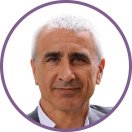 |
Peter Kurz
Chairman, Alpha Ring Asia
With a career spanning over 40 years, Peter Kurz has established himself as a leading financial commentator and analyst of Taiwan’s markets and industries, earning him the moniker Mr. Taiwan. In 2025, he was appointed as the Chairman of Alpha Ring Asia, a micro fusion technology company, while concurrently serving as the Chairman of Davos New Energy, an affiliated power storage company.
Until recently, Peter served for five years as the Chief Strategy Officer at Quantum International Corporation, where he advised companies on accessing international capital markets. Prior to joining QIC in 2019, he spent 12 years as the Head of Country Research and Managing Director of Citigroup Global Capital Markets (Taiwan), where he also served as Chairman.
Before Citigroup, Peter held similar leadership roles at other international financial institutions, including BNP Paribas, Merrill Lynch, ING Barings/Baring Securities—where he was instrumental in establishing their Taiwan operations—as well as Bear Stearns and the Bank of Boston. In addition to Taipei, he has worked in major financial centers around the world, including New York, London, Hong Kong, and Boston.
Throughout his career, Peter and his teams have consistently received top rankings in surveys conducted by Institutional Investor, Euromoney, and Asia money. |
|
|
| |
|
|
| |
Supported by:

Anthropocene Institute comprises scientists, engineers, communicators, marketers, thought leaders, and advocates — all pulling together toward a common goal: make Earth abundant for all and sustainable for decades to come.
Website: www.anthropoceneinstitute.com |
|
|
| |
|
|
| |
Community Partner:

Davos Club is a global, independent business and leadership community connecting founders, investors, innovators, and change-makers during Davos Week and beyond. Through curated events, strategic partnerships, and high-trust networks, Davos Club supports initiatives that drive meaningful dialogue, innovation, and positive global impact.
Website: https://davosclub.vip/ |
|
|
| |
|
|
| |
Lunch Sponsors:
Alpha Ring is a fusion technology company pursuing compact, modular approaches to clean energy through proton–boron fusion research. With teams and laboratories across Asia, California, and Europe, we bring together expertise in plasma physics, advanced engineering, simulation, and diagnostics to explore new pathways toward practical fusion energy.
Our work combines experimental research with international scientific collaboration to deepen understanding of fusion mechanisms and advance the technologies needed for their development. Alongside our energy research, we develop platforms for education and research and explore neutron-based medical applications. Our mission is to advance fusion science while translating technological progress nto practical benefits for society.
Website: https://alpharing.com/ |
|

WI Harper Group is a venture capital firm headquartered in San Francisco, with more than 30 years of experience backing innovative companies and deep connections across Asia. Across nine funds, the firm has committed over $1 billion to more than 250 companies, with over 100 successful IPOs and M&A transactions. WI Harper focuses on frontier computing and AI, advanced manufacturing, robotics and materials, healthcare and life sciences, and fusion and clean energy. Combining patient capital with hands-on support, the firm helps entrepreneurs translate scientific and technological breakthroughs into scalable businesses, connecting them with strategic partners, customers, manufacturing resources and global markets.
Website: https://wiharper.com/ |
|
|
| |
|
|
| |
Endorsed by:

The Australian Nuclear Association Inc (ANA) is the national body for nuclear professionals and people interested in nuclear science and technology in Australia. The ANA promotes the education, knowledge and practice of the peaceful, safe and effective use of nuclear science and technology to benefit people, science and the environment.
The ANA website is www.nuclearaustralia.org.au |
|

The Centre for Strategic Energy and Resources (CSER) is an independent think-and-do tank established in the spirit of “knowledge and innovation without borders”. With a vision of becoming the leading centre of excellence for strategic analysis and a thought leader in energy transition and sustainability, CSER is on a mission to build enabling ecosystems to accelerate energy transition pathways in Asia. Through a global network of experts from over 20 countries and organisations, CSER provides analysis of strategic options in energy, resources, and sustainable development to inform policy; develops appropriate solutions and their adoption strategies in response to the evolving global energy landscape; and promotes discussion and advance collective understanding on strategic issues related to energy and sustainable development. CSER is a collaborator of Green Denmark in Southeast Asia, an open community of thought leaders aiming to accelerate sustainable development and green collaboration.
For more information, visit www.cser.energy |
|

The Independent Power Professionals Forum (IPPF) is an international industry support organization composed of senior executives and decision-makers heading up firms with energy and power business commitments across Asia, Europe, Africa and the Americas. We are an active catalyst for positive change with a unique “fraternal” organizational atmosphere. We cover all key areas and sectors relating to power generation: Gas, Coal, Bio-Mass, Hydro, Wind, Solar, Nuclear, Geo-Thermal, Legal, Finance, Insurance, Security, Equipment, Infrastructure, Alternatives, Renewable and Sustainable Technologies, IoT / IT, etc.
The IPPF also leads the “New Energy” parade for Energy Efficiencies (EESCO’s), Pollution Prevention (P2/E2), GHG Trading, Energy Security, Waste-to-Energy, Standby Power, Smart Grid, Distribution / Transmission, Restructuring.
Website: www.ippfpowerasia.com |
|

WePlanet is a global network of grassroots organisations, scientists and citizens advocating for science-based solutions to the climate crisis, biodiversity loss, and sustainable development. As an independent, non-governmental organisation, WePlanet promotes pragmatic, evidence-based approaches across energy, agriculture and environmental policy — including the role of nuclear energy as part of a reliable, low-carbon energy system. Operating across multiple continents, WePlanet works to strengthen the public and policy foundations needed to deliver scalable, equitable and effective climate solutions.
Website: www.weplanet.org |
|

World Nuclear Association is the international organization that represents the global nuclear industry. Its mission is to promote a wider understanding of nuclear energy among key international influencers by producing authoritative information, developing common industry positions, and contributing to the energy debate, as well as to pave the way for expanding nuclear business.
For more information, visit world-nuclear.org |
|
|
| |
|
|
| |
Media Partners:

Energy Asia has, for the past 17 years, served as a multidisciplinary platform dedicated to the development, assessment and management of energy-related programs. Over the years, it has consistently worked to foster informed dialogue and deeper understanding within the energy sector. Through rigorous analysis and thoughtful evaluation, the publication strives to elevate the quality of discourse surrounding energy policies, innovations and challenges, positioning itself as a credible and influential voice in the evolving energy landscape.
Website: www.energyasia.co.in |
|

NucNet is an independent nuclear news agency based in Brussels, Belgium, that provides up-to-date information and analysis on developments in the nuclear energy industry worldwide. It focuses on topics such as nuclear power, reactor technology, policy updates, and energy market trends. NucNet serves a professional audience, including policymakers, industry experts, and stakeholders, offering reliable, fact-checked content and insights. With a focus on providing credible and fact-checked content, NucNet ensures its subscribers have access to the latest information needed to make informed decisions in the fast-evolving energy landscape. Whether it’s technical innovations, policy changes, or international collaboration, NucNet is a trusted source for staying informed in the nuclear field.
Website: www.nucnet.org |
|

Today there is no shortage of information on issues related to energy – magazines, newsletters, national newspapers, email newsletters, dedicated internet sites – the list goes on. Yet in this age of information overload, most professionals still take the time to read their favourite daily newspaper. The Energy Industry Times is a monthly newspaper dedicated to providing forward-looking reporting on the key issues driving this exciting sector. At last, an easy way to keep abreast of the latest news in the power and energy sectors – from a source you can trust.
Website: www.teitimes.com |
|

UxC, LLC is one of the nuclear industry’s leading market research and analysis companies. UxC offers a wide range of services spanning the entire nuclear fuel cycle with a special focus on market-related issues. UxC has decades of expertise and experience in supporting international clients on a wide range of strategic decision-making. UxC prides itself on its global approach to the nuclear markets and its complete independence from all other entities in the market. Our company has completed countless specialized studies on market issues in the global nuclear fuel cycle markets and employs a number of key experts with years of experience in providing specialized support to clients looking for unbiased advice on the nuclear markets. Over the years, UxC has been a leader in fundamental research on the SAMR and advanced reactor markets with unbiased analysis on leading technologies and the future outlook for this emerging reactor market sector.
Website: www.uxc.com |
|
|
| |
|
|
| |
Venue:
Sofitel Macau at Ponte 16
Rua do Visconde Paço de Arcos
Macau SAR
Tel: (853) 8861 0016 |
|
| |
|
|
| |
|
|
| |
Accommodation:
SUPERIOR ROOM CITY VIEW
| DATE |
OCCUPANCY |
ROOMS |
RATE |
INC. RATE |
| November 02, 03, 04 & 05 2026 |
Single |
Around 10-40 Rooms |
HKD$800+15% service charge & Govt Tax |
With 1 person breakfast |
| November 06 2026 |
Single |
Around 10-40 Rooms |
HKD$1,000+15% service charge & Govt Tax |
With 1 person breakfast |
| November 07 2026 |
Single |
Around 10-20 Rooms |
HKD$1,300+15% service charge & Govt Tax |
With 1 person breakfast |
(Occupancy Legend: S=Single, D=Double, T=Triple, Q=Quadruple)
SUPERIOR ROOM CITY VIEW (Double / Twin)
| DATE |
OCCUPANCY |
ROOMS |
RATE |
INC. RATE |
| November 02, 03, 04 & 05 2026 |
Double / Twin |
Around 5-10 Rooms |
HKD$900+15% service charge & Govt Tax |
With 2 persons breakfast |
| November 06 2026 |
Double / Twin |
Around 5-10 Rooms |
HKD$1,100+15% service charge & Govt Tax |
With 2 persons breakfast |
| November 07 2026 |
Double / Twin |
Around 1-5 Rooms |
HKD$1,400+15% service charge & Govt Tax |
With 2 persons breakfast |
(Occupancy Legend: S=Single, D=Double, T=Triple, Q=Quadruple)
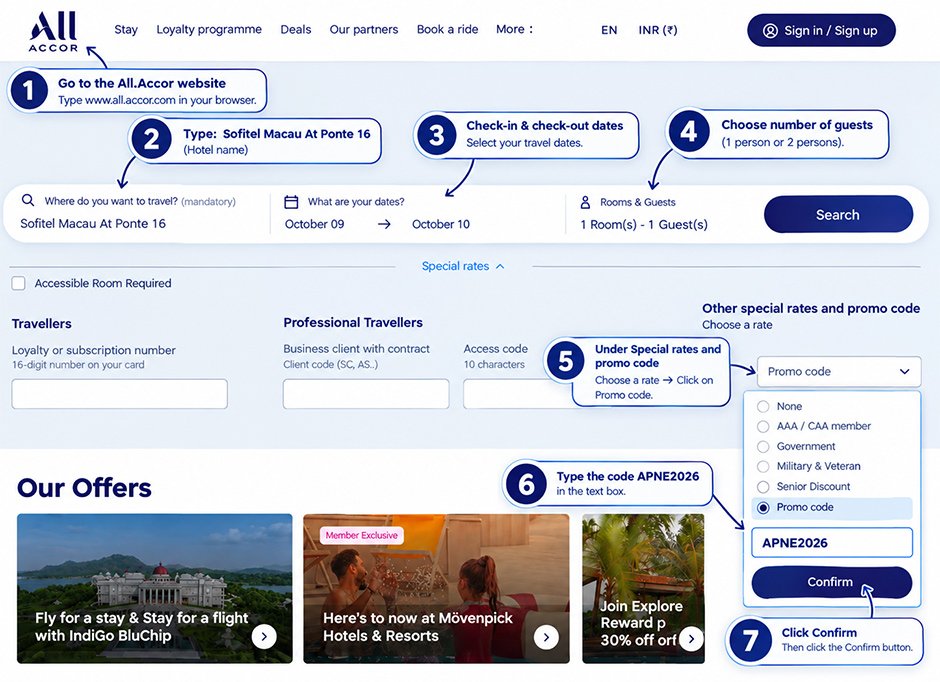
For online reservations, please click HERE.
The Promo code is APNE2026.
Please note that the link will be deactivated on 28 October 2026.
|
|
| |
|
|
| |
TOP |
|
| |
|
|
| |
Email: customerservice@stratcomsevents.com | Telephone: Christina Logan, Mobile: +64 21 858 455 |
|
| |
 |
|
|